Podcast of interview on OHS reviews

The recent article into the review of SafeWorkSA caught the attention of the Your Rights at Night radio program and led to an interview on 9 April 2015.  The podcast of that interview is now available online.

Interviews are odd experiences, particularly when they are over the phone.  Although there is a reason someone wants to talk with you, you usually do not know the questions beforehand.

For the interview above, I was in the bedroom, away from noises, with printed blog articles, media releases and OHS statistics across the pillows.  I thought the spread of information was important to have at hand to make sure the information I provided was accurate but one can still get caught out when the pace of the interview has settled. The last question asked in the interview could have been answered better.  Neither of the reviews announced have a fixed end date, regardless of what I said, in fact you can hear the shuffling of papers while I looked for the SA government’s media release. Oh well.

Kevin Jones

“The regulator should be respected, but not feared”

cover of Transforming Work Health and Safety Performance FINALHow different can occupational health and safety (OHS) regulators be? A review into WorkSafe Victoria was announced in February 2015 but the review into its equivalent in South Australia, SafeWorkSA, is more progressed and has released a public discussion paper entitled “Transforming Work Health and Safety Performance“. Its suggestions should be noted by James Mackenzie the reviewer of WorkSafe Victoria.

Maybe not surprising to many, the future is a reworking of the past.

Subscribe to SafetyAtWorkBlog to continue reading.
Subscribe Help
Already a member? Log in here

New research on OHS business case

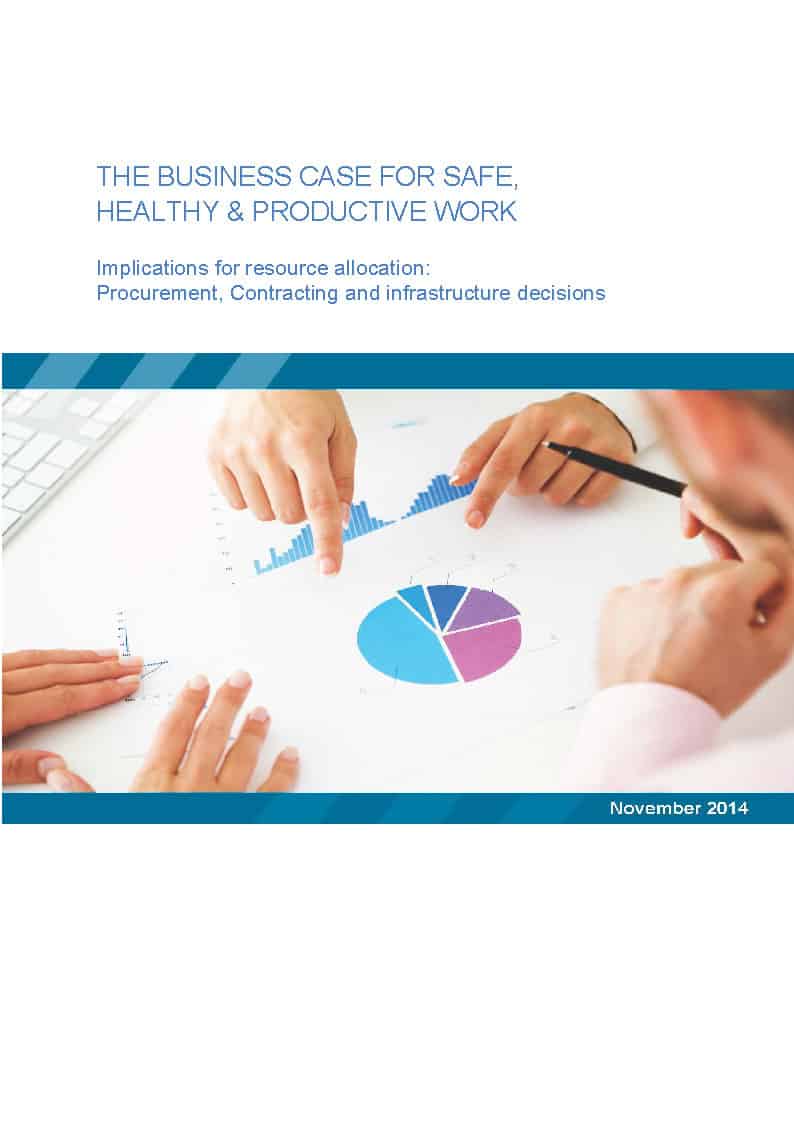
cover of business-case-for-safe-healthy-productive-workSafe Work Australia recently released its second research paper related to developing or communicating a business case for occupational health and safety (OHS).  The paper has been authored by Sharron O’Neill and is called “The Business Case for Safe, Healthy and Productive Work – Implications for resource allocation: Procurement, Contracting and infrastructure decisions“.  O’Neill’s paper clearly challenges the dominant thinking of OHS and costs.

O’Neill states that the quality of previous analyses of OHS business costs have been “fundamentally poor”, partly because

“Rather than strategically examining the cost-benefit to business of work health and safety, the typical ‘silo’-driven analysis produces a narrow focus on a very different concept; the cost-benefit to business of health and safety interventions. This has obscured much of the potential for improving  organisational productivity and operational decision-making.” (page 4, link added)

Subscribe to SafetyAtWorkBlog to continue reading.
Subscribe Help
Already a member? Log in here

Will workers be safer through an expansion of Comcare?

At a recent breakfast seminar, Steve Bell of Herbert Smith Freehills mentioned that a Bill is with the Australian Senate that will open up the Comcare scheme to Australian businesses through the removal of the national competition test.  This move has been flagged for some time with several lawyers expressing reservations.  Bell mentioned this to the audience of OHS professionals as the law changes could present a substantial change to their operational knowledge base. The Bill is part of a larger debate on OHS.

In a July 2014 article, the Australian Lawyers Alliance (ALA) warned that:

“The proposed changes to Comcare will not only throw state and territory-based workers’ compensation schemes into fiscal chaos, but will also see injured workers left out in the cold,” ALA National President Geraldine Collins said.

“If this legislation is passed, employers may move their workers into the Comcare scheme, thus leaving huge holes of unfunded liability in state schemes which is likely to result in state-based premiums soaring.”

“Opening up the Comcare scheme will be disastrous for workers. Comcare has no meaningful access to common law damages for injuries caused by the negligence of an employer. The scheme is burdensome, paternalistic, and bureaucratic for workers and employers.  Its design means premiums have to go up unless benefits are slashed ,” Ms Collins said.

“Comcare also has no meaningful workplace health and safety regime.  Work environments will develop where lives are lost and permanently damaged with little oversight and enforcement of workplace health and safety.  It is a fundamentally flawed minimalist scheme.  Migration en masse will strike at the heart of the financial stability of state schemes, which are mostly running fairly,” Ms Collins said.”

Continue reading “Will workers be safer through an expansion of Comcare?”

Queensland’s workers’ compensation performance is “double plus good”

The Queensland Premier, Campbell Newman, called a “snap” election for the end of January 2015. On 11 January 2015, Newman tweeted:

“Queenslanders injured at work are covered by Australia’s strongest workers’ compensation scheme.”

This is a further example of political newspeak as what does a “strong” workers’ compensation scheme look like? Newman’s tweet included an image that provides some clarity to his claim.

LNP WC Twitter graphic Continue reading “Queensland’s workers’ compensation performance is “double plus good””

Some are losing faith in the Victorian Workcover Authority

At a remembrance service in December 2014, the founder and outgoing deputy director of the Creative Ministries Network (CMN), John Bottomley, explained his refusal of funding from the Victorian WorkCover Authority (VWA) for CMN’s work-related grief support services (now called GriefWork). VWA has a different take on his comments.

In discussing the relevance of the Book of Isaiah to the motivations of the CMN to help people, Bottomley said that

“… it is God’s response to injustice and suffering that has planted this same spirit at the heart of our endeavours to transform work-related harm.

So CMN rejected VWA’s contract in April this year, after WorkSafe had funded our agency for over ten years to provide grief support services. My reason for rejecting the new contract was that VWA wanted to hide bereaved families grief from the public domain of injustice at work. The contract brief treated grief as an individual psychological problem to be addressed behind the closed doors of a clinic shut off from the rest of society. The contract wanted to treat work-related grief like an illness, and treat grieving families as sick and lacking the ability to ‘cope’. This heaps injustice upon injustice.”

Subscribe to SafetyAtWorkBlog to continue reading.
Subscribe Help
Already a member? Log in here

Workplace Safety finally gets a mention in the Victorian election campaign (sort of)

On 25 November 2014 the Federal Minister for Employment, Eric Abetz, attacked the Victorian Labor Party over its pledge to revoke the Construction Compliance Code which, primarily, deals with industrial relations but also has some occupational health and safety (OHS) requirements.

Abetz states that

“the Victorian Shadow Industrial Relations Minister [Natalie Hutchins] falsely claimed that the Code would not improve workplace safety, despite the numerous improved safety standards that it contains.”

The claim, apparently in the Herald-Sun newspaper, cannot be verified except through a reference in a news.com.au article. The original quote seems unavailable.

It is curious that this OHS criticism has come from a Federal Parliamentarian instead of from Victoria’s own Industrial Relations Minister and Attorney-General,

Subscribe to SafetyAtWorkBlog to continue reading.
Subscribe Help
Already a member? Log in here
Concatenate Web Development
© Designed and developed by Concatenate Aust Pty Ltd