
The COVID19 pandemic has devastated many countries but it has also created business opportunities. Recently workplace IT company Skedulo released a whitepaper about the new work normal. The document is essentially a marketing strategy but there are some hints about workplace change that may be of interest to occupational health and safety (OHS) advocates and professionals.
Category: workplace
Hospitality survey shows the size of the hurdle to reform
Hospo Voice, a trade union for Australian hospitality workers has released a report on a survey of more than 4000 workers between March and June 2020. #RebuildHospo: A Post-Covid Roadmap For Secure Jobs In Hospitality has all the limitations of other surveys done by members of an organisation rather than independent research but this report offers a framework for safe and decent work that reflects many of the occupational Health and safety (OHS) that SafetyAtWorkBlog has reported on.
The union claims that hospitality workers endorse four important work elements:
- Secure jobs,
- End to wage theft,
- Safe and respectful workplaces, and
- Justice for migrant workers
OHS has a thin presence in this report, mainly discussed in that third bulletpoint but an integrated analysis would show that OHS is involved with more of the elements.
Accusations of cover-up at Senate Estimates
Safe Work Australia also attended Senate Estimates late last month. COVID19 is an unavoidable focus but we learnt that the latest fatality report will be released early this month, obtained more details on the response to the Boland Report, heard more about the gig economy but the climax was accusations of a coverup with Senator Deborah O’Neill (ALP) saying:
“Minister Porter… influenced Safe Work Australia—how independent; running for cover!”
page 65, Hansard

What did we learn in Senate Estimates last week?
Australia has a process of accountability where Ministers and Heads of Government Departments and Authorities are required to answer attend Senate Estimates. Few people outside of the Canberra bureaucracy pay much attention to the occupational health and safety (OHS) information provided. Most media pay attention to disputes and statements that have a more general political appeal, but there is important information about workplace health and safety, such as an update of the progress on Marie Boland’s recommendations or the role and activity of Safe Work Australia (SWA).

Hoists and petards
Many on the Conservative side of Australian politics want to see Daniel Andrews, the Victorian Premier, fall, especially over the use of security guards in hotels used to quarantine returning travellers who may have had COVID19. Some of Andrews’ critics are being mischievous by linking the Industrial Manslaughter laws that his government introduced to his, and his Ministers’, accountability for COVID19 deaths linked to the hotels. The latest is Tasmanian Senator Eric Abetz in Federal Parliament.

Work-related mental health remains contentious
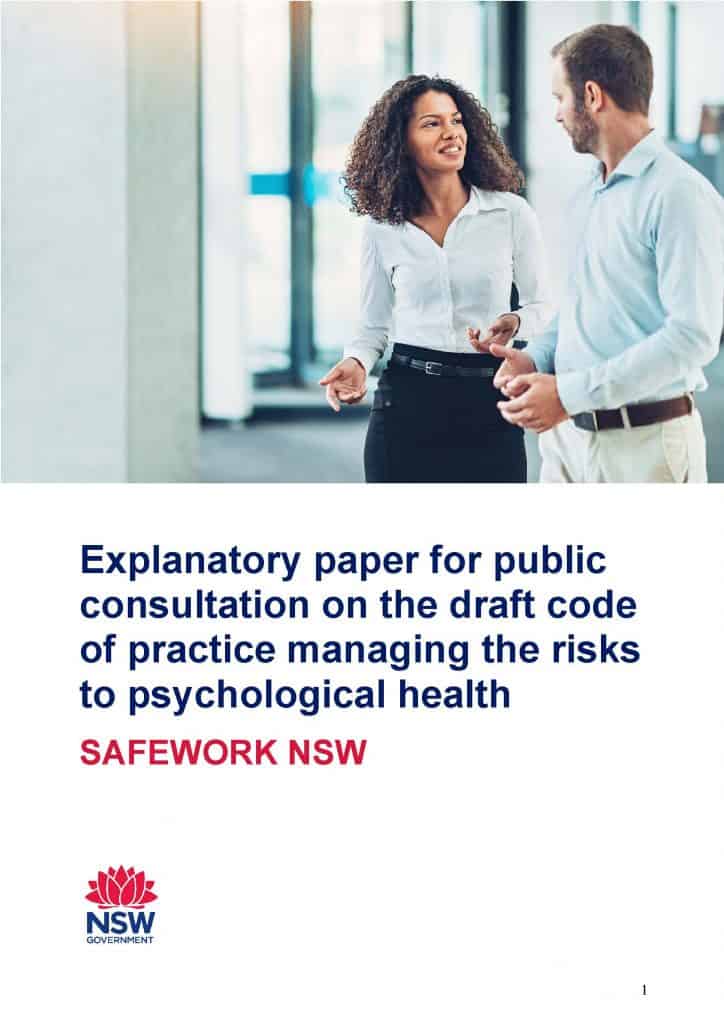
This article is about SafeWorkNSW’s recently released Draft Code of Practice for Managing the Risks to Psychological Health, but it is not going to focus on the Code. Instead the focus will be on the supplementary Explanatory Paper because this presents the rationale for the Code’s contents and, in many ways, is a more useful tool for occupational health and safety (OHS) discussions. However, just as the Code has structural and legislative limitations as part of its Purpose, the Explanatory Paper is a support document for submissions on the Draft Code and therefore has its own limitations.
Analysis of business impacts of COVID19

The Australian Industry Group recently released the results of a survey of its members about how COVID19 has affected their businesses. Understandably, the financial future of the businesses is the major concern but occupational health and safety (OHS) has been part of the business responses.
OHS was part of the initial scrabble to cope with the localised effects of a global pandemic. The report says
“Increased workloads due to new OH&S and healthcare procedures were still being reported by 6% of businesses in August, down from a high of 25% in the first stages of the pandemic in March. In Victoria, 10% of businesses reported concerns about the increase in this type of workload in August, compared with 2% in New South Wales and no businesses in Queensland.”
page 8