New OHS management elements in ISO45001

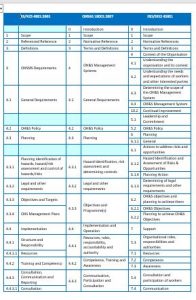
Following yesterday’s article on the impending international occupational health and safety (OHS) management Standard, ISO45001, some readers have asked for more details. David Solomon, the Head of the Australian International Delegation of ISO45001 provided a table that compares the elements of ISO45001 with AS4801 and OHSAS18001.
According to Solomon there are several elements that are new to ISO45001, ie. not included overtly in AS4801:

Subscribe to SafetyAtWorkBlog to continue reading.
Subscribe Help
Already a member? Log in here

Queensland’s report may not be “best practice” but demands attention

The Queensland Government has released the final report of its “Best Practice Review of Workplace Health and Safety Queensland“. Most of the media attention is given to the introduction of Industrial Manslaughter laws but there are some interesting recommendations and discussion on Enforceable Undertakings, insurance products and other matters of interest to business and safety professionals.

The Queensland Government announced the review earlier this year, particularly, in response to fatalities at Dreamworld and Eagle Farm. A Discussion Paper was released in April.

Industrial Manslaughter

Industrial Manslaughter laws have been floating around Australia’s occupational health and safety (OHS), legal union and political sectors for many years.  Only the Australian Capital Territory (ACT) introduced such a law and the Crimes (Industrial Manslaughter) Amendment Act 2003 remains in effect.

The significance in this Queensland report is that the document is entitled “Best Practice” so the panel, based on its own experience and the many submissions it received, adds considerable weight to these controversial laws.

Subscribe to SafetyAtWorkBlog to continue reading.
Subscribe Help
Already a member? Log in here

OHS gets talked about in WA Parliament

On 17 August 2017, Matthew Swinbourn of the Australian Labor Party spoke, at length, in the Western Australian Parliament about workplace safety.  His address did not seem to be prompted by an industrial relations dispute or a recent fatality but is supportive of general occupational health and safety (OHS) principles and the changes in WA law to improve compatibility with the Work Health and Safety laws and obligations in other States.

The response from the former Minister for Commerce and Liberal Party member, Michael Mischin,  was a curious mix of rebuttals and was one of several Parliamentarians who chose to speak about workplace safety in that State’s Legislative Council.

According to Hansard for that day, Swinbourn mentioned the substantial cost burden on individual workers and their families of workplace injuries.

“Of these costs—this was a surprising figure to me—the overwhelming majority, 95 per cent, is borne by individuals and society. Workers bore 77 per cent of those costs, the community 18 per cent and employers five per cent.”

Subscribe to SafetyAtWorkBlog to continue reading.
Subscribe Help
Already a member? Log in here

Alt-Safety

Last week I asked a question of a panel of occupational health and safety (OHS) regulators about ‘safety differently’.  It was something like

“Does OHS/WHS law need to change to accommodate ‘safety differently’ and are any of you applying these principles in your own organisation?”

Part two of the question was ignored and Part One needed clarification as the previous day’s conference discussion of ‘safety differently’ by QantasLink and others wasn’t obvious. The OHS profession and businesses need a new easily digestible term for “safety differently”.  Continue reading “Alt-Safety”

SafetyConnect conference connects

This week’s SAFETYconnect conference hosted by the NSCA Foundation in Sydney had a very good strike rate of interesting speakers on its first day.  Only one speaker missed the safety mark – it was as if they had been handed a marketing presentation instead of safety and, regardless of the safety audience, give it anyway.

This conference was notable for the way that the ‘safety differently’/Safety II movement has moved into mainstream safety management.  The most obvious example of this was a presentation by QantasLink.

Subscribe to SafetyAtWorkBlog to continue reading.
Subscribe Help
Already a member? Log in here

Configuring the safety profession for the future

In support of this year’s election of new Board members to the Safety Institute of Australia, the Safety on Tap podcast has granted each nominee ten minutes to introduce themselves.  Some of these episodes raised the following points of interest:

  • The need to change the demographics of the occupational health and safety (OHS) profession to reflect society.
  • Any organisation that is undergoing change must acknowledge that even though it may be replacing “old school” thinking and structures, sustainable progress is best achieved by accepting the future is built by “standing on the shoulders of giants”.
  • Just because an organisation or profession has been structured one way in the past does not mean that structure remains applicable for the future.

Continue reading “Configuring the safety profession for the future”

You can learn so much more from a Near Miss – Interview with James Wood

James Wood was injured during work on an Australian mine site in 1985 resulting in spinal cord damage and other complications. For a long time, James has been telling his story to Australian workers for them to understand the risks they face, primarily, at work. I caught up with James on a very cold morning at a lovely café in Victoria’s Yarra Valley earlier this month.

SAWB: James, I heard you talk about your workplace injury and the disruption and the consequences of that at least 15 years ago at a breakfast meeting. It was extremely effective, and a powerful message. Fifteen years later you’re still doing that. Why tell your story? Why would anybody want to hear it?

JW: Well, there’s probably a couple of answers, Kevin. I share my story and my experiences because I know how my workplace accident changed my life and I know how it affected a lot of the people around me at the time. My family, workmates, friends. I believe that by sharing my story, I can give people a little bit of information about what it’s like to get hurt at work or even away from work.

I honestly hope that by telling people how I got hurt and how it changed my life, it can give people the reason to maybe use some of the training that we’re all given. To use the systems and the procedures that most workplaces have and try and stop somebody else from getting hurt.

Subscribe to SafetyAtWorkBlog to continue reading.
Subscribe Help
Already a member? Log in here
Concatenate Web Development
© Designed and developed by Concatenate Aust Pty Ltd