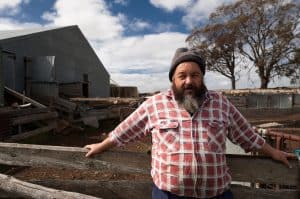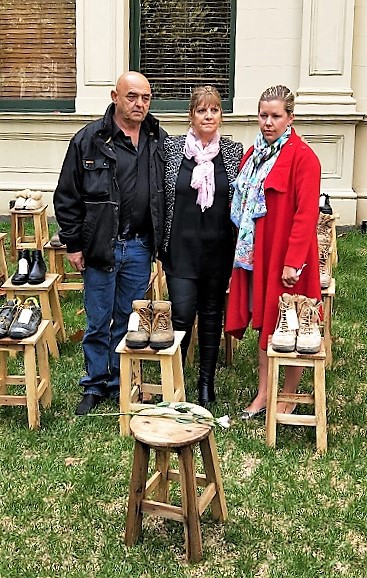
Interview with Dr Gerry Ayers

This weekend is the International Workers Memorial Day.  In Victoria, in particular and in Australia more generally, it is highly likely that the issue of Industrial Manslaughter laws will be raised as part of a trade union campaign.

Dr Gerry Ayers, the OHS&E Manager of one of the branches of the CFMEU, features in an online petition about these laws and it seemed the right time to interview Dr Ayers about these laws but also about workplace health and safety enforcement and practices more generally.

Subscribe to SafetyAtWorkBlog to continue reading.
Subscribe Help
Already a member? Log in here

FIFO, Fairness and the Future

Trucks in Super Pit gold mine, Kalgoorlie, Western Australia

SafetyAtWorkBlog’s article about the safety of Fly-In, Fly-Out workers has generated some discussion through its mention on LinkedIn which has raised some interesting points.

A common thread seems to be that it is impractical to build townships and facilities to support remote mine workers and which also provide services to workers’ families. One commenter posed these questions:

“Are we going to drag the FIFO families out to these areas, build houses for them, along with all the associated infrastructure to support them, for what may be only a 3-5 year construction program? Is it fair to drag the partners and families of FIFO workers away from their family supports (parents/friends, etc)? Away from decent medical care? Away from schools/universities?”

This may have been intended as rhetorical but prompts a question that I frequently ask when I consult with clients – “why not?”

Subscribe to SafetyAtWorkBlog to continue reading.
Subscribe Help
Already a member? Log in here

We need to ask tougher questions about FIFO

On the recommendation of one of my subscribers I am currently listening to a podcast called Food For Thought which includes a discussion on the mental health issues associated with the Fly-In -Fly-Out (FIFO) work structure.  This article is being written as I listen to the podcast so follows the threads as spoken.

Various major Australian inquiries have been held into the occupational health and safety of FIFO workers for the mining sector. The potential psychological harm of FIFO is indisputable so why aren’t we asking the tough questions and thinking about the harm that we are allowing to occur?

Source: istockphoto

Continue reading “We need to ask tougher questions about FIFO”

Pfeffer cuts through on OHS

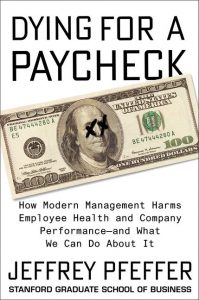
“…if we truly care about human beings and their lives, including how long people live…. we need to first understand and then alter those workplace conditions that sicken and kill people” (page 25 – “Dying For A Paycheck”)

Jeffrey Pfeffer has been doing the rounds of the Safety and Human Resources conferences for some time, talking about “dying for a paycheck”.  This year he published a book of that title, a book that should be obligatory reading for occupational health and safety (OHS) professionals and, more importantly, company executives.

This book is one of the few that I have read from cover-to-cover and wanted to do so in as short a time as possible because I wanted to understand the big interconnected picture of business management and policy setting that Pfeffer discusses.

Pfeffer presents a lot of data packaged in a fresh and fascinating form but regularly complains about the lack of data.  One of the joys in the book is being tantalised by what data he presents but then being frustrated when realising that that is the extent of the data available.   Continue reading “Pfeffer cuts through on OHS”

Robotics may cause an apocalypse if you’re male, old and low-skilled

Australia’s Office of the Chief Economist has released its first Industry Insights document for 2018.  This one focusses on flexibility and growth and included this statement in the chapter written by Andrew Charlton, a Director, of AlphaBeta :

“At the macroeconomic level, much of this change has been positive. The economy has created new jobs that are, on average, better paid, more satisfying and safer than the jobs that were lost.” (page 19)

Safer jobs? The last claim sent me to the source of the data – 

Subscribe to SafetyAtWorkBlog to continue reading.
Subscribe Help
Already a member? Log in here

A new Senate inquiry into industrial deaths

Canberra, Australia – October 14, 2017: A view inside Senate chamber in Parliament House

Another Australian Government inquiry into workplace health and safety (WHS) was announced on March 26 2018.  According to the Senate Hansard, the Senate’s Education and Employment References Committee will report on a range of occupational health and safety (OHS) matters by the end of September 2018.

Subscribe to SafetyAtWorkBlog to continue reading.
Subscribe Help
Already a member? Log in here

Queensland’s “production versus protection dichotomy”

Last week the Queensland Government proposed changing some of the health and safety laws that relate to mining.  Changes to occupational health and safety (OHS) laws that improve workplace safety are almost always welcome, but to some extent these recent changes are “catch-up”.

The Government’s media statement of the proposed laws is very positive and the changes are largely very good.  Natural Resources, Mines and Energy Minister Dr Anthony Lynham is quoted saying

“The Department’s mines inspectorate through their investigations have found that one of the causes of an increase in risk is due to contractors not having a full understanding of the SHMS on the mining site…”

Subscribe to SafetyAtWorkBlog to continue reading.
Subscribe Help
Already a member? Log in here
Concatenate Web Development
© Designed and developed by Concatenate Aust Pty Ltd