Industrial Manslaughter arguments cover old ground

The Queensland Government is in the middle of a debate in Parliament and the media about the introduction of industrial manslaughter as an offence related to serious occupational health and safety (OHS) breaches.  It is both a good and a bad time for this debate. The laws are likely to pass but the debate is showing old arguments, weak arguments, political expediency and union-bashing but not a lot about improvement in workplace safety.

Timeline

Following two major fatal workplace incidents, in April 2017 the Government established an

Subscribe to SafetyAtWorkBlog to continue reading.
Subscribe Help
Already a member? Log in here

Near Kill – Jim Ward speaks

Jim Ward is hardly known outside the Australian trade union movement but many people over the age of thirty, or in the occupational health and safety (OHS) profession, may remember the person Esso blamed for the Esso Longford explosion in 1998.  Just after the nineteenth anniversary of the incident that killed two workers and injured eight other, SafetyAtWorkBlog interviewed Ward about the incident but, more significantly, also about how that incident changed his world view.

For some time now Jim Ward has been the National OHS Director for the Australian Workers’ Union.  Here is a long interview with Ward that provides a useful perspective on OHS while Australia conducts its National Safe Work Month.

[Note: any links in the text have been applied by SafetyAtWorkBlog]

SAWB: Jim, what happened at Longford, and what did it mean for you.

JW:   So, on 25 September 1998, I got up out of bed and went to work, just as I’d done for the previous 18 years of my working life, at the Esso gas plant facility at Longford in Victoria.

There was nothing unforeseen or untoward about that particular day.  But due to, as one judge elegantly described it, “a confluence of events”, it turned out to be the most significant day of my life.

Subscribe to SafetyAtWorkBlog to continue reading.
Subscribe Help
Already a member? Log in here

Workplace mental health and wellbeing strategies must consider suicide

There is an increased blurring between the workplace, work and mental health.  In the past, work and life were often split implying that one had little to do with the other except for a salary in return for effort and wellness in preparation for productiveness.  This split was always shaky but was convenient for lots of reasons, one of which was the management of occupational health and safety (OHS).  However that perceptual split is over, now that mental health has come to the fore in many OHS considerations.

Recently

Subscribe to SafetyAtWorkBlog to continue reading.
Subscribe Help
Already a member? Log in here

The clash between money and lives

A media release from Australia’s Minister for Employment, Michaela Cash, starts the theme of management of workers compensation on the cusp of National Safe Work Month.  The purpose of the media release is ostensibly to celebrate that Comcare has become a fully funded scheme for the first time since 2010 but this is undermined by party politics:

“These results are another clear example of the Turnbull Government cleaning up after Labor’s slack financial management, while still delivering the most efficient and effective service for injured and ill employees.

Under Labor, Comcare had become a budget black hole into which taxpayer’s money simply disappeared.”

Continue reading “The clash between money and lives”

Tassie Coroner releases his safety findings on 7 quad bike deaths

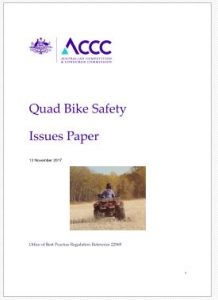
Coincidentally, as an article about quad bike safety was being uploaded to this blog, details of the release of Tasmanian coronial findings were received.  The findings were released by Coroner Simon Cooper on August 25 2017 and were not reported widely.

The Coroner investigated seven deaths related to quad bikes but only two occurred on workplaces or as part of performing work – Heather Richardson and Roger Larner. Curiously, WorkSafe Tasmania did not investigate these work-related deaths.   Continue reading “Tassie Coroner releases his safety findings on 7 quad bike deaths”

Queensland’s report may not be “best practice” but demands attention

The Queensland Government has released the final report of its “Best Practice Review of Workplace Health and Safety Queensland“. Most of the media attention is given to the introduction of Industrial Manslaughter laws but there are some interesting recommendations and discussion on Enforceable Undertakings, insurance products and other matters of interest to business and safety professionals.

The Queensland Government announced the review earlier this year, particularly, in response to fatalities at Dreamworld and Eagle Farm. A Discussion Paper was released in April.

Industrial Manslaughter

Industrial Manslaughter laws have been floating around Australia’s occupational health and safety (OHS), legal union and political sectors for many years.  Only the Australian Capital Territory (ACT) introduced such a law and the Crimes (Industrial Manslaughter) Amendment Act 2003 remains in effect.

The significance in this Queensland report is that the document is entitled “Best Practice” so the panel, based on its own experience and the many submissions it received, adds considerable weight to these controversial laws.

Subscribe to SafetyAtWorkBlog to continue reading.
Subscribe Help
Already a member? Log in here

OHS gets talked about in WA Parliament

On 17 August 2017, Matthew Swinbourn of the Australian Labor Party spoke, at length, in the Western Australian Parliament about workplace safety.  His address did not seem to be prompted by an industrial relations dispute or a recent fatality but is supportive of general occupational health and safety (OHS) principles and the changes in WA law to improve compatibility with the Work Health and Safety laws and obligations in other States.

The response from the former Minister for Commerce and Liberal Party member, Michael Mischin,  was a curious mix of rebuttals and was one of several Parliamentarians who chose to speak about workplace safety in that State’s Legislative Council.

According to Hansard for that day, Swinbourn mentioned the substantial cost burden on individual workers and their families of workplace injuries.

“Of these costs—this was a surprising figure to me—the overwhelming majority, 95 per cent, is borne by individuals and society. Workers bore 77 per cent of those costs, the community 18 per cent and employers five per cent.”

Subscribe to SafetyAtWorkBlog to continue reading.
Subscribe Help
Already a member? Log in here
Concatenate Web Development
© Designed and developed by Concatenate Aust Pty Ltd