
Recently I attended an occupational health and safety (OHS) conference in New Zealand which had a good representation of students. One, Catherine Boyle, has an online survey operating for OHS managers and she is looking for participants.
As a health and safety professional working in a managerial capacity, you are invited to participate in a research project. This project aims to identify the health and safety behaviours that you either engage in or delegate to others in your workplace. This research is being conducted as part of a Masters dissertation in Applied Psychology. Your involvement will entail the completion of a brief survey, which should take no more than fifteen minutes. Participation is voluntary, confidential and anonymous. The results of the project may be published but there will be complete confidentiality of the data gathered. You will also have access to the results of the research should you wish to see them. If you are willing to participate in this research, please click on the link below. Thank you in advance for your participation.
http://canterbury.qualtrics.com/jfe/form/SV_d0EFmjaxLW9afKl
Masters Student, Catherine Boyle, University of Canterbury, New Zealand.


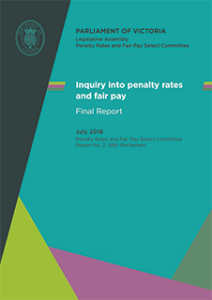 Australia currently has a lot of official inquiries into workplace issues that affect the occupational health and safety (OHS) of workers. It is almost impossible to keep up with them and, as a result, some important voices are being missed, but even if they spoke, there is a strong chance they will not be listened to. The Victorian Government has released the final report of the Inquiry into Penalty Rates and Fair Pay. There are two overt mentions of OHS that don’t seem to go anywhere.
 Let’s acknowledge the problems with this year’s
  Australian research usually makes use of the industrial and activity categories created by the