Zero, health and people – themes of the World Congress on Safety & Health

In front of thousands of delegates and dignitaries, the 21st World Congress on Safety and Health was officially opened yesterday by the Singapore Prime Minister Lee Hsien Loong.

There are three themes of this conference:

  • Vision Zero – From Vision to Reality
  • Healthy work—Healthy life
  • People-centred prevention
Subscribe to SafetyAtWorkBlog to continue reading.
Subscribe Help
Already a member? Log in here

SafetyConnect conference connects

This week’s SAFETYconnect conference hosted by the NSCA Foundation in Sydney had a very good strike rate of interesting speakers on its first day.  Only one speaker missed the safety mark – it was as if they had been handed a marketing presentation instead of safety and, regardless of the safety audience, give it anyway.

This conference was notable for the way that the ‘safety differently’/Safety II movement has moved into mainstream safety management.  The most obvious example of this was a presentation by QantasLink.

Subscribe to SafetyAtWorkBlog to continue reading.
Subscribe Help
Already a member? Log in here

You can learn so much more from a Near Miss – Interview with James Wood

James Wood was injured during work on an Australian mine site in 1985 resulting in spinal cord damage and other complications. For a long time, James has been telling his story to Australian workers for them to understand the risks they face, primarily, at work. I caught up with James on a very cold morning at a lovely café in Victoria’s Yarra Valley earlier this month.

SAWB: James, I heard you talk about your workplace injury and the disruption and the consequences of that at least 15 years ago at a breakfast meeting. It was extremely effective, and a powerful message. Fifteen years later you’re still doing that. Why tell your story? Why would anybody want to hear it?

JW: Well, there’s probably a couple of answers, Kevin. I share my story and my experiences because I know how my workplace accident changed my life and I know how it affected a lot of the people around me at the time. My family, workmates, friends. I believe that by sharing my story, I can give people a little bit of information about what it’s like to get hurt at work or even away from work.

I honestly hope that by telling people how I got hurt and how it changed my life, it can give people the reason to maybe use some of the training that we’re all given. To use the systems and the procedures that most workplaces have and try and stop somebody else from getting hurt.

Subscribe to SafetyAtWorkBlog to continue reading.
Subscribe Help
Already a member? Log in here

Reviewing fundamentals is part of cultural change

The most recent stuff-up by the Commonwealth Bank of Australia has strengthened calls for a Royal Commission into Australia’s finance and banking sector. This is of interest to workplace safety professionals because it contains the liveliest current discussion about corporate cultures – how flawed ones are supposedly behind the errors and how proactive ones are supposed to be the solution.

Occurring at the same time is a growing social movement that is recalibrating occupational health and safety (OHS) to see workers as humans of value rather than units of labour.

Paralleling all of this is increased attention on the sociology and psychology of work, perhaps linked to a decline in the neoliberalism of the past forty years.  As Australia enters the time of OHS conferences and Work Safe Month in October, it may be worth considering a couple of fundamental questions, such as absolute safety, AFAIRP, and invisible hazards.

Subscribe to SafetyAtWorkBlog to continue reading.
Subscribe Help
Already a member? Log in here

University sexual assault – an OHS perspective

The community and media responses to the Australian Human Rights Commission report into sexual assault and harassment in Australian universities continue but until the Australian Government responds, it is unclear how the risks will be reduced, particularly as many members of the current Federal Government have been openly hostile to the AHRC and its previous Commissioner, Gillian Triggs.  After having rubbished the Commissioner and the institution, how will the government respond?

Following on from the very popular SafetyAtWorkBlog article about the report yesterday, it is worth looking at the AHRC recommendations in the occupational health and safety (OHS) context.

It should be noted that OHS places the principal responsibility on the employer, in this instance, the universities and the Vice-Chancellors.  Some have already started to call on the government to play a role, with implications that it should be leading the change: Continue reading “University sexual assault – an OHS perspective”

What is Farm Safety Week really saying about safety?

This week is Farm Safety Week in Australia.  This means that a lot of organisations will be issuing media releases about how to either, improve safety performance (ie. reduce harm) or raise awareness of risks and safety.  What is likely to be missing from the information is practical information.  This is partly because of the unique nature of farmers – isolated, small businesses, politically conservative and working from home.

Safe Work Australia

On the first day of the week Safe Work Australia (SWA) released an

Subscribe to SafetyAtWorkBlog to continue reading.
Subscribe Help
Already a member? Log in here

RTW seminar hints at WorkSafe Victoria’s future

Victoria Australia has had a network of safety groups for well over 40 years with two or three enduring into this century.  On 5 July 2017, the Ballarat Regional Occupational Safety and Health Group (BROSH) held an interactive seminar on Return-To-Work (RTW). The discussion was not revolutionary but allowed the audience – a mix of businesses, OHS professionals and students – to speak about their lived experiences with managing injured workers.

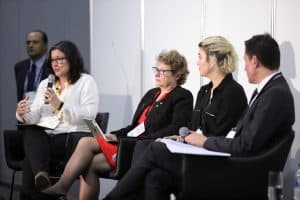
I brought the WorkSafe 2030 Strategy discussion paper to the audience’s attention and a WorkSafe representative from the seminar’s panel, pictured above, said that there are several weird technical suggestions for workplace inspections and advice emerging from the discussion within the OHS regulator.  However the strategy is focussed always on the client and that it is “prevention-led”. OHS is all about the prevention of illness and injury but it appears that WorkSafe is extending this term to RTW.

The representative explained that the regulator is looking at interventions that prevent an injury or illness claim transforming into, or contributing to, another and new injury.  They hope that by focussing on the injured worker and providing the right level of advice and support, the will achieve the best RTW outcome for all involved.

One of the questions from the audience was if there is a better RTW and workers’ compensation system that Victoria could move to or learn from.  The panel agreed that the Victorian system seems to be leading Australia in terms of its financial health but, more importantly, the level of care and support options provided to injured workers.

The BROSH seminar was well attended and the audience was active, which largely resulted from the innovative and engaging seminar structure.

Kevin Jones

Concatenate Web Development
© Designed and developed by Concatenate Aust Pty Ltd