
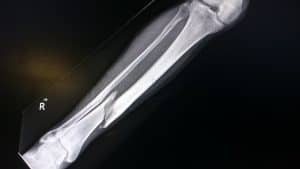
 On November 9 2017, the Australian Institute of Health and Welfare (AIHW) released statistical data on work-related injury. This data included statistics from workers compensation but also statistics about hospitalised injuries that were identified as work-related but funded by sources other than workers’ compensation. The report also provides a different perspective on mental health.
Category: mental-health
What do Weinstein, Spacey and others have to do with OHS?
“Then I went, ‘Oh hang on, I’ve normalised so much of this as part of my industry…. This last three months has really made us all take a long hard look at what we have even let ourselves think is acceptable.” – Sacha Horler

Such a statement is familiar to those working in the field of occupational health and safety (OHS). This normalisation, or habituation, has underpinned much of the discussion of what builds a safety culture – “the way things are done round here”. As a result of revelations and accusations pertaining to Gary Glitter, Rolf Harris, Jimmy Saville, Robert Hughes, Harvey Weinstein, and Kevin Spacey, the entertainment industry around the world has been forced to assess the fundamental ethics on which sections of its industry are based. Continue reading “What do Weinstein, Spacey and others have to do with OHS?”
Latest safety culture report on construction has lessons for all
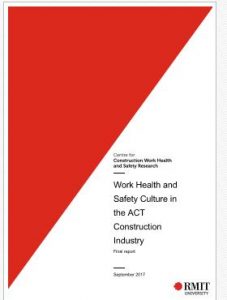 In 2012, the Australian Capital Territory (ACT) government undertook a review of safety in its construction industry and produced a report called “Getting Home Safely“. In early 2017, the Government contracted RMIT University to review the construction sector’s work health and safety culture in the aftermath of the 2012 report and government actions since them. The September 2017 report was only recently made public.
The RMIT University report includes a very good and super-current discussion about safety culture and safety climate but its findings are of limited help in improving OHS performance in the construction sector.
Look to the source of workplace conflict, exploitation and injustice
 Occupational health and safety advocates are pushing for safety management and strategies to refocus on people by talking about “people-centric” approaches and recalibrating legislation to re-emphasise prevention. This push parallels society’s frustration with political strategies that favour big business, the under-investment in education and health care systems and companies that announce record profits at the same time as sacking staff. That frustration is becoming accepted by political parties that are starting to apply more people-centric policies or by countries and States that are appointing representatives from outside the mainstream political organisations.
At a closing event for National Safe Work Month on 1 November 2017, WorkSafe Victoria’s CEO,
Can flexible work arrangements apply in the construction sector?
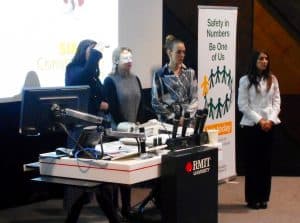 On 30 October 2017, the Safety Institute of Australia and RMIT University held their annual OHS Construction Forum. This year’s theme was flexible working arrangements – a brave choice that did not really work but was indicative of safety in the construction industry generally.
Several speakers discussed well-being generally and how flexible working arrangements were critical to fostering an appropriate level of wellness. One, a labour lawyer, outlined the legislative obligations that companies have to those types of arrangements with reference to equal opportunity laws, industrial relations and anti-discrimination obligations – sadly the workplace safety laws and obligations were not mentioned. In all of the wellbeing-themed discussions, the application to the on site construction workers was rarely, if ever, mentioned.
Acts of God, the morality of safety – interview with Sidney Dekker
 The latest episode of Safety At Work Talks is a return to the sequence of interviews with Professor Sidney Dekker. In April 2017, Dekker published a book called The End of Heaven which discusses suffering. This book has a very different tone from his previous books and is intriguing.
The breadth of the discussion was also surprising with concepts and references rarely talked about in relation to occupational health and safety, such as morality, Acts of God, train disasters and the Bible. If this sounds heavy, it is useful to follow the discussion that leads to this statement from Dekker:
“Safety Culture is the new Human Error”.
This latest episode is available at
Soundcloud: https://soundcloud.com/safetyatworkblog/safety-at-works-talks-episode-03
Podbean: https://safetyoz.podbean.com/
Discussion of corporate culture includes OHS even when it doesn’t
 The political debate about the dysfunctional culture of Australia’s banking sector has diminished to a discussion, and that discussion continues to bubble along, mostly, in the Australian Financial Review (AFR). The discussion is important for the occupational health and safety (OHS) profession to watch as any change in safety management systems will occur within the corporate or organisational culture.
Two (possibly paywalled) articles appeared this week in the AFR – “