
Speculation is occurring about the introduction of Industrial Manslaughter (IM) amendments by the incoming Labor Government in New South Wales. It is likely, as the Australian Labor Party, when in opposition last year, introduced an IM Bill into Parliament. But Industrial Manslaughter laws promise more than they deliver as the push for these laws is based on politics rather than justice or workplace health and safety.
Category: mental-health

A Neverending Story – Supply chain safety dispute
Several weeks ago, Scott’s Refrigerated Logistics, a prominent Australia trucking company, entered receivership. It seems the Transport Workers’ Union (TWU), as part of a long campaign, chose to take another potshot at one of Australia’s few supermarkets, Aldi, accusing it of “pressuring supply chains” when the average profit margin in this sector has been described as an average profit margin of only 2.5 per cent. Occupational Health and Safety (OHS) in Australia’s transport industry has always been an important issue and is regularly a political football.
The union’s claims are being echoed by Senator Tony Sheldon, a former national secretary of the TWU, in Parliament.

The well-being and psychosocial “wild west”
With the new Psych Health and Safety regs/codes of practice, it seems many corporate ‘wellness’ providers are now branching out into the now topical, psychosocial risk management domain. As someone who supports several national/multinational organisations, I am seeing a big gap between the academic research, provider capability, corporate understanding, and real-world activity. I am also seeing some very questionable tools/approaches/programs and activities emerging in the race to sate the increasing corporate psych risk appetite.
[Guest post by David Burroughs]
Continue reading “The well-being and psychosocial “wild west””
“Some of you may die, but it’s a sacrifice I am willing to make”
Recently at the Central Safety Group, I offered two business options to prevent and manage the risks of mental injury at work – Employ more people or Descope company expectations. This was glib, but I was trying to simplify the decisions that employers will face if they choose to meet their occupational health and safety (OHS) obligations. The reality of the decision-making process is challenging, but it seems to me that the core decisions are to increase the workforce to adequately and safely meet the needs of the company or project, or reduce the production volume or decrease the expectations of the client, and the related stress levels of the workers, to match the size of the workforce.
The actual decision is more complex, but this choice is fundamental to the prevention of harm and compliance with the OHS laws.

Getting the (political) balance right
One can never accuse politicians of deep or systems thinking on the issues and policies for which they are responsible. Victoria’s Minister for WorkSafe, Danny Pearson, spoke at a press conference on March 6, 2023, about the viability of the workers’ compensation systems, which he described as broken, during a substantial increase in claims for workplace mental injury. Premier Dan Andrews has spoken of this matter since and with a similar perspective – politics rather than occupational health and safety (OHS).
How this issue develops over the next month may determine who speaks for the government at the April 28 Workers Memorial event.
Hubris, thy name is HR
The Human Resources (HR) sector often feeds off itself, reinforcing what it has always done, rather than seriously looking at opportunities to improve from outside its own experience and discipline. Workplace mental health is a particular example.
Recently the Human Resources Director (HRD) website promoted a new well-being survey from AON with the headline:
“Want to boost company performance? Invest more in wellbeing – Higher wellbeing scores can enhance performance by up to 55%: Aon report”
My initial response was WTF?! But after giving up some of my identity data to the website and reading the AON Report. My surprise diminished as I realised the report was just another example of comforting a profession on a workplace issue about which it is losing control.
Differing perspectives on working hours
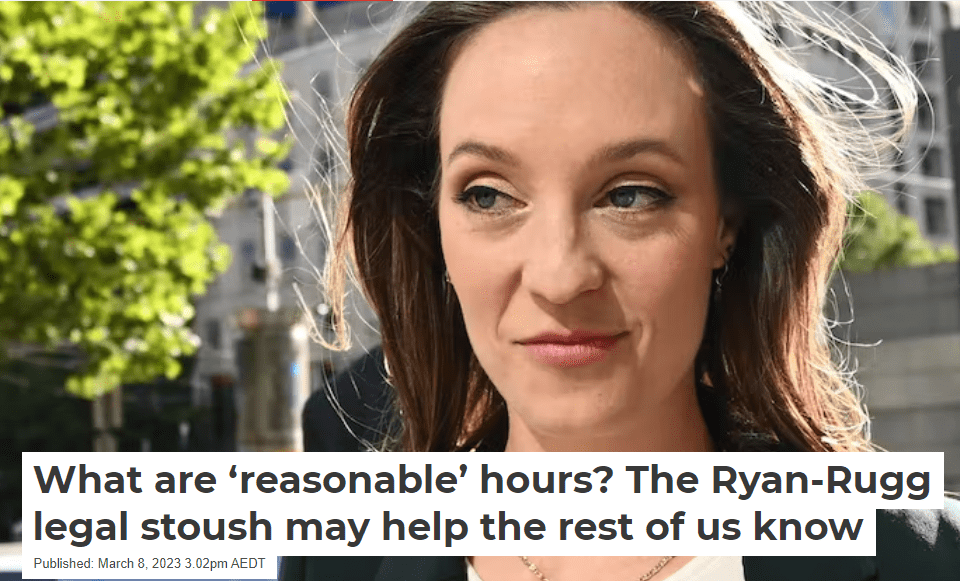
On March 8, 2023, Giuseppe Carabetta, Associate Professor, University of Technology Sydney, wrote about how the current dispute between Politician Monique Ryan and her former Chief of Staff, Sally Rugg, could open the door to lots of legal action through the courts and the Fair Work Commission. Sadly occupational health and safety (OHS) does not feature, but let’s look at the industrial relations context first and consider what is meant by “reasonable”.