Review of West Gate Bridge findings has important lessons for modern infrastructure projects

2020 will be the fiftieth anniversary of the collapse of the West Gate Bridge which resulted in, amongst others, the deaths of 35 workers, changed Victoria’s approach to occupational health and safety (OHS), instigated a Royal Commission into the disaster, strengthened trade union influence and established an industrial antagonism to the John Holland group of businesses that continues today.
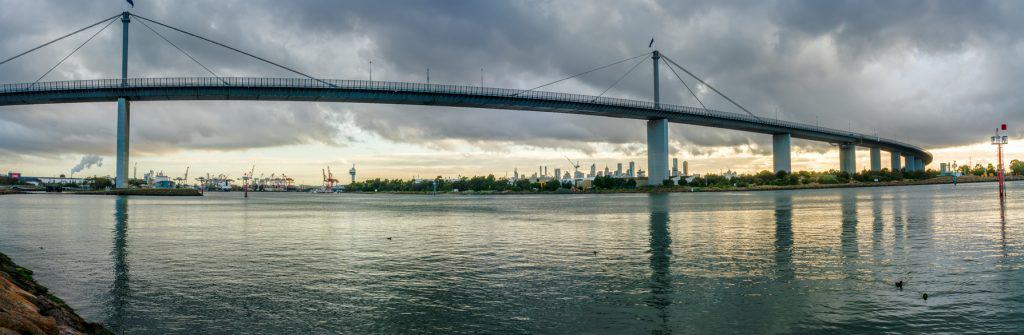
Panorama of West Gate Bridge in Melbourne at sunset in summer.

Last week,

Subscribe to SafetyAtWorkBlog to continue reading.
Subscribe Help
Already a member? Log in here

Inquiry into industrial deaths moves to Adelaide

Conversations about occupational health and safety (ohs) occur very rarely unless you are an educator who talks about this stuff every day.  We manage health and safety and advise on it but rarely get a chance just to talk about safety with peers.  This is where documents like the recent transcripts of Australia’s Senate inquiry into industrial deaths can be helpful.  For instance Andrea Madeley said this on August 29 2018 in Adelaide:
“I do not think that the Robens model of work health and safety was ever based on anything beyond encouragement. It was a model designed to lift and encourage employers, not to enforce laws, and we see that today, still. The guiding principles, even today, on enforcing work health and safety laws really are more about encouraging and educating. I don’t have a problem with that as long as we’re not treating the people that are suffering in the process like outcasts. Their loss is virtually ignored unless you happen to be a financial dependant.”

Given that it occurred almost fifty years ago, it is easy to forget the times in which Lord Robens issued his report into the management of workplace health and safety.  It was controversial in its day and the Australian iterations of his OHS principles were similarly opposed when they were introduced in the 1980s. 

Subscribe to SafetyAtWorkBlog to continue reading.
Subscribe Help
Already a member? Log in here

Arts Wellbeing Collective gets a future

In November 2017, SafetyAtWorkBlog wrote about a pilot occupational health and safety (OHS) and wellness program created by the Victorian Arts Centre.  At the time the future of this very good program was in doubt as continuing funding was not available.

On August 30 2018, Victorian Premier, Daniel Andrews, pledged some funding to the Arts Wellbeing Collective.  How much funding has not been revealed but providing a future for the program is a sound OHS and political move.

A major attraction of the Arts Wellbeing Collective is that it was an initiative from outside the established OHS and Human Resources networks.  This cuts out a lot of baggage but also risks acting without an understanding of what has gone before.

Perhaps more importantly, this program is not a response to the Weinstein issues or the #metoo agenda.  It was developed prior to both of these events but will benefit from the profiles these tragedies have created. All strength to it.

Kevin Jones

Solar panel pledge incorporates workplace safety

Victoria’s Premier Daniel Andrews announced a State-supported program to install solar  panels on an estimation of 65,00 homes if his Labor Party is re-elected this November.  This election campaign announcement immediately reminds voters of the last government-sponsored “green” program, the Home Insulation Scheme which, amongst other results, lead to the deaths five workers.

Unsurprisingly,

Subscribe to SafetyAtWorkBlog to continue reading.
Subscribe Help
Already a member? Log in here

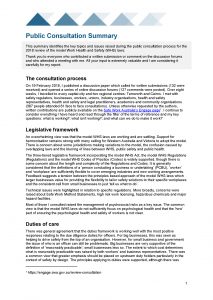
Boland releases Public Consultancy Summary of WHS inquiry

The Independent Review of Model WHS Laws being conducted by Marie Boland released a Public Consultation Summary on August 17 2018.  Boland lists the concerns raised with her as including:

“the blurring of lines between WHS [work health and safety], public safety and public health”

“The length and complexity of the Regulations and Codes”

Subscribe to SafetyAtWorkBlog to continue reading.
Subscribe Help
Already a member? Log in here

Front page OHS article gives half the story

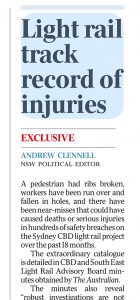
Years ago I was advised how to read a newspaper article – the first two paragraphs and the last.  The exclusive front page article in The Australian ($ paywalled) on August 15 2018 about occupational health and safety (OHS) management at Sydney’s light rail construction project is a good example of what journalists choose to write and what they are obliged to write.

“A pedestrian had ribs broken, workers have been run over and fallen in holes, and there have been near-misses that could have caused deaths or serious injuries in hundreds of safety breaches on the Sydney CBD light rail project over the past 18 months.

The extraordinary catalogue is detailed in CBD and South East Light Rail Advisory Board minutes obtained by The Australian.”

and

Subscribe to SafetyAtWorkBlog to continue reading.
Subscribe Help
Already a member? Log in here

Is the Senate a workplace?

Recently Australian media was entranced with an argument over gender politics between two Senators, David Leyonjhelm and Sarah Hanson-Young.  One of the elements in the argument concerns sexual harassment in the workplace but is the Australian Parliament a workplace like any other Australian workplace? And does this really matter?

In the aftermath of the initial argument, Prime Minister Malcolm Turnbull said:

“David Leyonhjelm’s offensive remarks should have been withdrawn the moment they were uttered and he should have apologised. And it’s not too late for him to withdraw and apologise.

That type of language has no place in Parliament and it shouldn’t have a place in any workplace. We have to treat each other with respect, we must do that. Respect for women in particular is one of the highest priorities that we should be focused on. I just want to be very clear about this.

It is a, you know, we often talk about domestic violence and our concerns there and all the measures we’re taking to address it. I just want to say this, it’s a reminder to everybody that not all disrespecting women ends in violence against women, but that is where all violence against women begins. So you need to have respectful workplaces where we treat each other with respect. Where we disagree, we disagree in respectful language……” (emphasis added)

Subscribe to SafetyAtWorkBlog to continue reading.
Subscribe Help
Already a member? Log in here
Concatenate Web Development
© Designed and developed by Concatenate Aust Pty Ltd