
Companies are being urged to increase their attention on the human impacts of incidents. This is a much-needed and delayed focus that existed decades ago but went out of fashion. Companies can achieve these changes after a lot of hard work and expense, but very little attention has been given to the institutions and government policies that perpetuate the “individual pathology” of workplace incidents. Some recent sociological research helps us see the immorality behind the status quo.
Category: research

When Work Kills: Unmasking Suicidality in Corporate Australia
For over twenty years, John Bottomley has been researching the influence of work factors in suicide. His early research is rarely referenced, and although only a small sample was studied, his findings were significant. New research, published recently in the Journal of Industrial Relations, adds an essential perspective as Australia continues to progress (painfully slowly) on the prevention of workplace psychosocial hazards.
Note: this article discusses work-related suicide

Adam Smith, Mental Health, and the Moral Case for Safer Productivity
Adam Smith was a prominent Scottish 18th-century economist and philosopher, sometimes referred to as the “Father of Economics”. What relevance could he have to occupational health and safety (OHS) in Australia? The modern OHS concern of psychosocial hazards, psychological safety and worker wellbeing should cause us to read Smith’s works on the morality of capitalism. Instead, we should read a new book called “What would Adam Smith make of modern Australia?”, written by Joseph Healy.
Stop Trying to Sell Safety with GDP Statistics
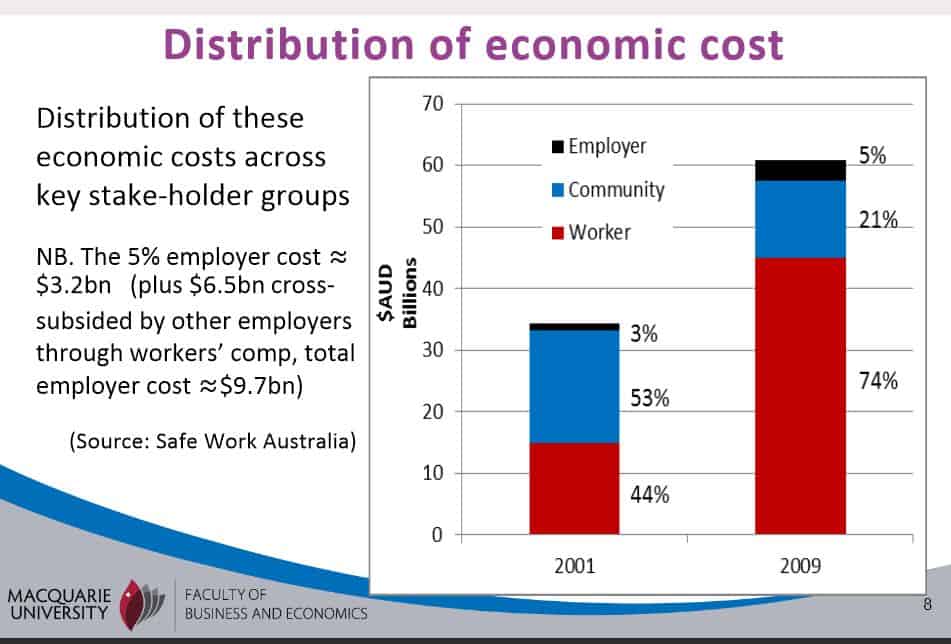
The cost of work-related illness and injuries is a significant economic burden on the community. It has a tangible impact on Australia’s Gross Domestic Product (GDP), but no one really gives a shit about this. The GDP impact is a nonsense statistic in the illustration of how injuries and illnesses affect Australian businesses. The economic arguments need reframing if an improvement in workplace health and safety is the intention.

Good Safety Grows Economies—Poor Governance Shrinks Them
Recently, WorkSafe ACT posted the latest episode of its Safety Spotlight podcast in which occupational health and safety (OHS) experts share their knowledge. There is commonality with much OHS advice, but there are slight variations of data and emphasis that are useful to note.
This episode included Jacqui Agius, the Australian Capital Territory’s Work Health and Safety Commissioner, and Professor Helen Lingard of RMIT University. According to the show notes:
“….they discuss the crucial importance of workplace safety, not just in preventing injuries but also its economic impact. The episode covers the hidden costs of cutting corners on safety, the significance of a proactive safety culture, and the benefits of consulting workers and employing safety by design.”

Deterrence Delayed, Lives at Risk—Will Victoria’s Leaders Respond?
The Victorian Government has yet to respond to a report on occupational health and safety (OHS) sentencing and penalties that it received over the Christmas period. The longer it takes to respond to the Sentencing Advisory Council recommendations, the more delayed the action required to improve the systems, which can deter employers from ignoring their OHS obligations and the longer unnecessary risks to work health and safety persist.
In 2018, before the introduction of Industrial Manslaughter laws, Dr Gerry Ayres of the CFMEU and I spoke about the importance of deterrence. In that interview, he pointed out that financial penalties fail as deterrents for several reasons:

Safety With Minimal Jargon: Tim D’Ath’s Refreshing Approach
Late last year, Tim D’Ath added to the occupational health and safety management (OHS) literature with a modern, open-minded (and short) book called “Humanising Safety”. His perspective cuts across many of the heady discussions of Safety I vs. Safety II, safety cultures, and organisational versus individual approaches… I found his clarity of advice refreshing, as he focused on core harm prevention principles while acknowledging the difficulty of communicating these principles to employers who have been taught to view OHS as a nuisance to be avoided whenever possible.