
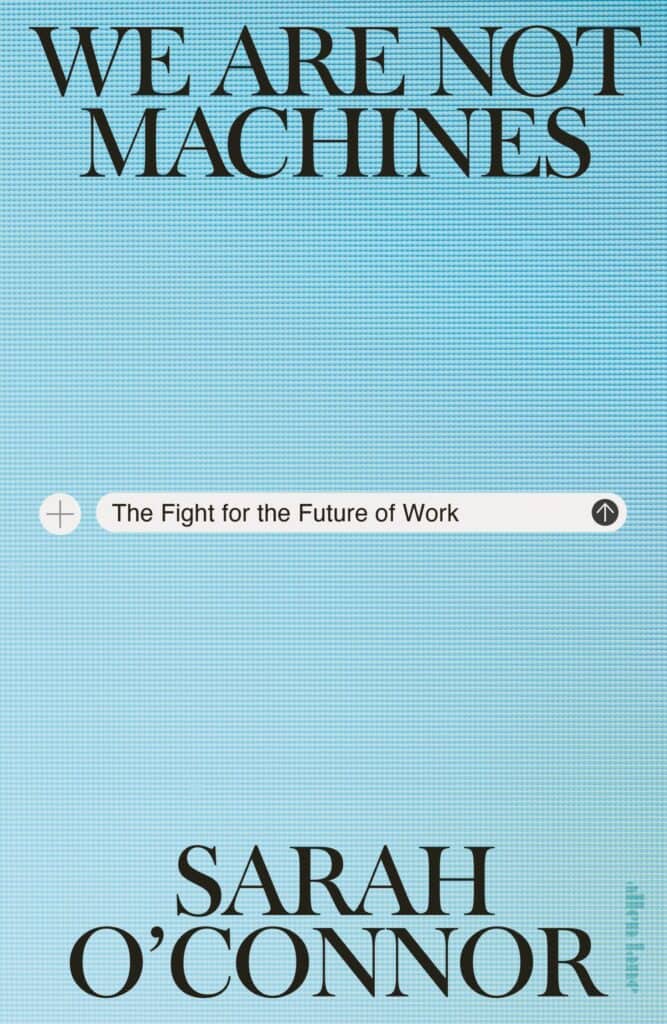
Sarah O’Connor has written an interesting book on artificial intelligence (AI) and work. According to a newspaper review of the book, which is to be released in a couple of weeks, O’Connor says that AI is not the existential threat that some fear and that AI advocates promote.
“What makes the difference, according to O’Connor, is worker participation in decisions about how the technology is used.”
As the May 23 2026, article from The Times is paywalled, below is an AI-generated summary:
Sarah O’Connor challenges the narrative that artificial intelligence is an unstoppable force destined to reshape work without human input. O’Connor’s reporting, based on real-world interviews with workers across various industries, reveals that while AI can make jobs more efficient, it often fragments human roles and increases surveillance, sometimes leading to distressing working conditions. However, she also finds examples where AI has improved safety and job satisfaction, especially when workers have a say in how technology is implemented.
The central argument is that society is not powerless in the face of AI; human agency and collective action, such as strong unions and negotiated agreements, can shape how technology affects work. The article notes that while O’Connor highlights the importance of regulation and worker participation, she does not fully address the complexities of global regulation. Ultimately, the book is praised for its grounded, human-centred perspective and its call for proactive engagement with technological change.
I will have to wait for the Kindle version available in the next few weeks to understand her examples of safety improvements, but an odd one is referenced in the article:
“In a Swedish mine, for instance, the introduction of self-driving trucks, cameras and wifi has made the jobs more productive, safer and pleasanter (the miners can listen to Spotify as they work).’
This innovation in a Swedish mine needs much more context. The work may have become “pleasanter”, but listening to Spotify while working may be the type of distraction that increases danger.
The reviewer, Emma Duncan, writes that O’Connor believes that tech companies:
“.. want people and governments to believe that [AI] is not only beneficial, in that it will do the boring bits of work and leave the fun bits for people, but also unstoppable.”
I think we see this approach among some AI speakers at OHS seminars and conferences.
The review fails to use the word “automation”, but I can’t help thinking that the discussion about AI and work needs to be seen within the context of the automation of work that has been happening for two centuries. Duncan’s review touches on the history, but hopefully O’Connor compares the social and psychological disruption presented by AI in the context of automation. (Her publisher’s blurb implies she will) I would argue that automation usually creates as many hazards in workplaces as it has solved. This may be even truer if we consider the broader social impacts.
Duncan says that O’Connor’s book is flawed.
“… there’s a piece missing from O’Connor’s argument: how we should control or shape the flow. “Be Scandinavian” is one answer, but not widely available. “Have big, powerful unions” is another, but it has downsides. “Regulate” is the most obvious, and O’Connor gestures towards it, but doesn’t engage with the principal difficulty — that regulation encourages firms to move their operations across borders.”
The Scandinavian suggestion, outside Scandinavia, is almost always wishful thinking, as the work and social structures have been shaped over decades and on very different social and political foundations than elsewhere. Unions have been historical agents of change and still have influence based largely on their legacy and historical presence rather than on membership or broad social support. Too many books about work speak wistfully of the extent of change available to trade unions, but trade unions in Australia and elsewhere carry significant social baggage. Union membership is a great advantage to workers, but employers oppose it, and workers question their return on investment of union dues, especially when they are constantly assaulted with negative stories of union corruption and violence. The trade union with the most members in Australia may be the Australian Education Union, but the social image of unionists is that of construction-industry intimidators. Workers need a new non-union voice.
Regulation is a common response to technological, social and occupational change, but all regulation assumes an agreement to comply from those affected. Compliance is never guaranteed, and all regulations have an enforcement element because the government knows that the compliance assumption is severely flawed. Introducing positive duties on psychosocial hazards and sexual harassment, for instance, are fine, but not all employers have goodness in their hearts, especially when compliance reduces profits.
One book website includes this quote from Sarah O’Connor:
“Automation was meant to do away with dull, dirty, dangerous tasks. It was meant to free us up for more interesting and creative work. So why was my notebook filling up with stories of good jobs turned bad, and bad jobs turned worse? These people were not being liberated by machines. Instead, they were being crunched into systems run by machines and paced by machines, in which important concepts such as fairness, intelligence, even human-ness itself, were being quietly redefined by machines. And that left me with a question. A question that prompted me to write this book. We think we’re robotizing our work, but what if we’re actually robotizing ourselves?”
Emma Duncan’s review is perceptive and says good things about O’Connor’s book, but I think we also need a review from the OHS perspective. Give me a couple of weeks.