Industrial Manslaughter laws in Australia are about politics, not safety

The latest push for Industrial Manslaughter laws in Australia has appeared as part of the Tasmanian state election.

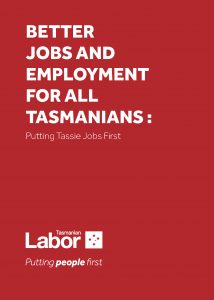
The Tasmanian branch of the Australian Labor Party released its policy platform for jobs in February 2018 which makes specific and vague commitments on workplace safety which require scrutiny.

Precarious Work

The Tasmanian Labor Leader, Rebecca White, states that

“Labor is committed to addressing casualisation and the outsourcing of work…”
Subscribe to SafetyAtWorkBlog to continue reading.
Subscribe Help
Already a member? Log in here

Farm newspaper supplement gets a good wrap

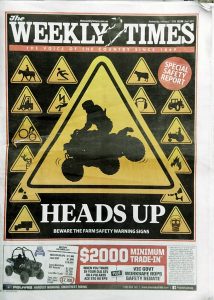
The Weekly Times newspaper has included an 8-page wraparound to its 7 February 2018 edition about workplace safety. The supplement is timely, the contents are indicative of cultural and political changes and the supplement is a nice summary of the multiple hazards and management approaches needed in agriculture (the same as in most industries, really).

Data quoted liberally from

Subscribe to SafetyAtWorkBlog to continue reading.
Subscribe Help
Already a member? Log in here

Victoria is ripe for Industrial Manslaughter laws

The Victorian trade union movement is preparing for the November 2018 State Election with one element of that campaign being the advocacy of Industrial Manslaughter laws.

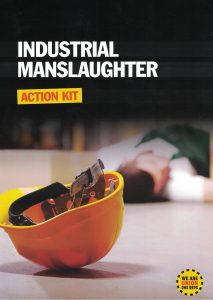
At the end of January 2018, the unions “kicked off” their campaign with a meeting which reviewed the challenges and wins for injured workers in 2017 and outlined their intentions for 2018. The Industrial Manslaughter Action Kit included a petition which says: Continue reading “Victoria is ripe for Industrial Manslaughter laws”

Who reads the Robens Report and who will write the next one?

“Every year something like 1,000 people are killed at their work in this country. Every year about half a million suffer injuries in varying degrees of severity. 23 million working days are lost annually on account of industrial injury and disease.”

The existence of this statement is of no surprise to occupational health and safety (OHS) professionals. Similar statements are made all the time.  The sad surprise of this quote is that it appeared in 1972 on page 1 of the Safety and Health at Work – Report of the Committee 1970-72, otherwise know as the Robens Report.

Perhaps it is time to begin contemplating what OHS fundamentals we should apply in the next generation of workplace safety health and wellbeing laws ?

Subscribe to SafetyAtWorkBlog to continue reading.
Subscribe Help
Already a member? Log in here

Out of Range – Work Risks of Wildlife Protection Officers

by Melody Kemp

 It was nine at night and the shooters had the advantage of superior fire power and night vision goggles …. We stood no chance. Two friends were killed…”

Source: Project Anoulak

David Paklett, a Wildlife Ranger working in Tanzania pulled up his trouser leg and showed me an ugly red scar that looked a bit like an alien pasted to his skin. It was 2013. We were in Spain’s ancient university town of Salamanca, at WILD 10, a sporadic gathering of wilderness and conservation specialists.  He told me how the year before, he and his colleagues had been in a John Woo style shoot out with Vietnamese poachers. The Vietnamese were overhead in a helicopter, firing at them with automatic rifles. ‘It was nine at night and the shooters had the advantage of superior fire power and night vision goggles.’

His words have stayed with me.

‘We stood no chance. Two friends were killed, and I got this.’ When I looked up, his eyes had the look of someone who was looking back with horror. ‘Did you ever talk about that night with anyone?’ I asked sipping a Rioja red. ‘Who is there to tell?’ David grimaced. ‘It’s part of the job. The game has changed. The Chinese are arming these guys and making sure they get away with the kill. The forces behind them are so powerful and we have no resources.’

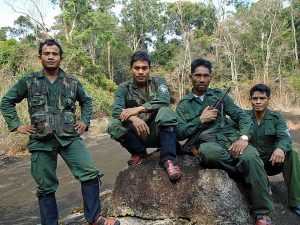
Lao Rangers in the Annamite mountain range report the same fear according to Bill Robichaud. ‘Camera traps showed these guys (poachers) to have the latest technology, to be well dressed and armed, with modern communication and GPS gear.’ Continue reading “Out of Range – Work Risks of Wildlife Protection Officers”

Review into WorkSafe Victoria released at Christmas

In the middle of 2017 SafetyAtWorkBlog asked why the Victorian Government was slow in releasing the report of an independent review into its occupational health and safety (OHS) regulator, WorkSafe.  Victorians have received a Christmas present with the release of the report of the  Independent Review of Occupational Health and Safety Compliance and Enforcement in Victoria and the Government response.

In Principle

According to the Minister for Finance Robin Scott’s media release, dated 18 December 2017,

“The review was a Labor Government election commitment and made 22 recommendations – all of which the Government supports in principle.” (emphasis added)

Subscribe to SafetyAtWorkBlog to continue reading.
Subscribe Help
Already a member? Log in here

Victoria joins the push for licencing labour hire

Victoria is the latest Australian State to introduce laws into Parliament that establish a licencing scheme for labour hire operators. The Labour Hire Licensing Bill 2017 was read into Parliament on 14 December 2017 (Hansard, pages 55-61)

The Bill is compatible with the laws passed recently in Queensland and South Australia which apply a universal licencing scheme rather than a sectoral one as preferred by some organisations.  This should make the scheme easier to administer as it removes demarcation disputes and, as pointed out by the Minister for Roads and Road Safety, Luke Donnellan, removes loopholes of opportunity for avoiding obligations – a critical consideration in a sector that has shown such disregard for legal obligations. Continue reading “Victoria joins the push for licencing labour hire”

Concatenate Web Development
© Designed and developed by Concatenate Aust Pty Ltd