Sexual harassment may be an OHS issue but what priority should it receive?

One online news site in Australia has suggested that sexual harassment is an occupational health and safety (OHS) issue.  At first blush, it should be.  Sexual harassment can create mental ill-health and can certainly be harmful. But from the early days of discussions about workplace bullying and occupational violence in Australia, sexual harassment has been consciously excluded from OHS.

Is It or Isn’t It?

Some of the best discussion on bullying, harassment and violence was written by Dr Clare Mayhew for the Australian Institute of Criminology in 2000.  These included a practical handbook on prevention. (It’s peculiar that some of the most perceptive works on OHS occur outside the OHS profession.  Well perhaps not so surprising.)  In the handbook, Mayhew points out that harassment has always been an element of workplace bullying but excludes sexual harassment from her discussion:

“The Australian Institution of Criminology believes that prevention, rather than post-incident reaction, is the key to improved outcomes. However, the handbook needs to be adapted specifically to each organisation for best results. The discussions exclude activity that could be described as sexual harassment, which is extensively dealt with elsewhere.” (page 1)

This position is reflective of the OHS literature yet, on reflection, this position may have been wrong for it contributed to a fractured approach to managing workplace psychosocial hazards. 

Subscribe to SafetyAtWorkBlog to continue reading.
Subscribe Help
Already a member? Log in here

Rail-related suicides discussed at ergonomics conference

Rail-related suicides are tragedies that ripple throughout society affecting families of the suicides as well as the train drivers, their families and their colleagues. Various strategies are being trialled but often the results of interventions are hard to quantify.  At the annual conference of the

Subscribe to SafetyAtWorkBlog to continue reading.
Subscribe Help
Already a member? Log in here

The Safety Anarchist

Professor Sidney Dekker has a new book out called “The Safety Anarchist – 
Relying on human expertise and innovation, reducing bureaucracy and compliance“.  Last month Sidney spoke exclusively with SafetyAtWorkBlog about the issues of governance, risk assessment, the safety profession, bureaucracy, centralisation and the cost of compliance.  The full conversation is available at the Safety At Work Talks podcasts and below.

Subscribe to SafetyAtWorkBlog to continue reading.
Subscribe Help
Already a member? Log in here

Look to the source of workplace conflict, exploitation and injustice

Occupational health and safety advocates are pushing for safety management and strategies to refocus on people by talking about “people-centric” approaches and recalibrating legislation to re-emphasise prevention.  This push parallels society’s frustration with political strategies that favour big business, the under-investment in education and health care systems and companies that announce record profits at the same time as sacking staff.  That frustration is becoming accepted by political parties that are starting to apply more people-centric policies or by countries and States that are appointing representatives from outside the mainstream political organisations.

At a closing event for National Safe Work Month on 1 November 2017, WorkSafe Victoria’s CEO, 

Subscribe to SafetyAtWorkBlog to continue reading.
Subscribe Help
Already a member? Log in here

OHS gets talked about in WA Parliament

On 17 August 2017, Matthew Swinbourn of the Australian Labor Party spoke, at length, in the Western Australian Parliament about workplace safety.  His address did not seem to be prompted by an industrial relations dispute or a recent fatality but is supportive of general occupational health and safety (OHS) principles and the changes in WA law to improve compatibility with the Work Health and Safety laws and obligations in other States.

The response from the former Minister for Commerce and Liberal Party member, Michael Mischin,  was a curious mix of rebuttals and was one of several Parliamentarians who chose to speak about workplace safety in that State’s Legislative Council.

According to Hansard for that day, Swinbourn mentioned the substantial cost burden on individual workers and their families of workplace injuries.

“Of these costs—this was a surprising figure to me—the overwhelming majority, 95 per cent, is borne by individuals and society. Workers bore 77 per cent of those costs, the community 18 per cent and employers five per cent.”

Subscribe to SafetyAtWorkBlog to continue reading.
Subscribe Help
Already a member? Log in here

What is Farm Safety Week really saying about safety?

This week is Farm Safety Week in Australia.  This means that a lot of organisations will be issuing media releases about how to either, improve safety performance (ie. reduce harm) or raise awareness of risks and safety.  What is likely to be missing from the information is practical information.  This is partly because of the unique nature of farmers – isolated, small businesses, politically conservative and working from home.

Safe Work Australia

On the first day of the week Safe Work Australia (SWA) released an

Subscribe to SafetyAtWorkBlog to continue reading.
Subscribe Help
Already a member? Log in here

No review report but WorkSafe Victoria releases a discussion paper on its future

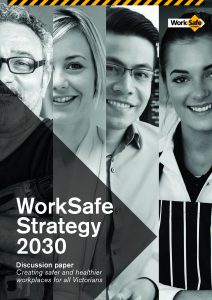
WorkSafe Victoria has released a discussion paper in support of its development of a WorkSafe Strategy 2030 but you wouldn’t know it.  At the time of writing – there is no mention of it on the Facebook page, nothing on its news website.  The paper is only available through this rarely used community engagement page.

One of this blog’s readers drew attention to this paragraph on page 8 which indicates that WorkSafe Victoria is basing part of this discussion paper on recent reports which seem to include the Independent OHS Review which is yet to be publicly released:

“A number of independent reviews undertaken recently have also highlighted opportunities for us to strengthen our approach to regulating health and safety in Victorian workplaces, and in further supporting injured workers.

We know in some cases we are not meeting the expectations of the community, and the outcomes of these reviews are informing the development of our strategy, and the way we deliver our services in the future.”

It would be good to know what failed community expectations are being referred to.

Subscribe to SafetyAtWorkBlog to continue reading.
Subscribe Help
Already a member? Log in here
Concatenate Web Development
© Designed and developed by Concatenate Aust Pty Ltd