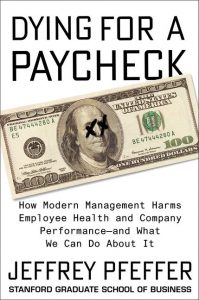
Pfeffer cuts through on OHS

“…if we truly care about human beings and their lives, including how long people live…. we need to first understand and then alter those workplace conditions that sicken and kill people” (page 25 – “Dying For A Paycheck”)

Jeffrey Pfeffer has been doing the rounds of the Safety and Human Resources conferences for some time, talking about “dying for a paycheck”.  This year he published a book of that title, a book that should be obligatory reading for occupational health and safety (OHS) professionals and, more importantly, company executives.

This book is one of the few that I have read from cover-to-cover and wanted to do so in as short a time as possible because I wanted to understand the big interconnected picture of business management and policy setting that Pfeffer discusses.

Pfeffer presents a lot of data packaged in a fresh and fascinating form but regularly complains about the lack of data.  One of the joys in the book is being tantalised by what data he presents but then being frustrated when realising that that is the extent of the data available.   Continue reading “Pfeffer cuts through on OHS”

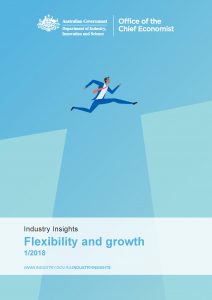
Robotics may cause an apocalypse if you’re male, old and low-skilled

Australia’s Office of the Chief Economist has released its first Industry Insights document for 2018.  This one focusses on flexibility and growth and included this statement in the chapter written by Andrew Charlton, a Director, of AlphaBeta :

“At the macroeconomic level, much of this change has been positive. The economy has created new jobs that are, on average, better paid, more satisfying and safer than the jobs that were lost.” (page 19)

Safer jobs? The last claim sent me to the source of the data – 

Subscribe to SafetyAtWorkBlog to continue reading.
Subscribe Help
Already a member? Log in here

Old books, contemporary advice

Recently I searched the book shops online for some old and rare occupational health and safety (OHS) books.  I often bang on about needing to understand OHS beyond our own professional and academic life times, as OHS, like any other discipline, continues to evolve.

Below are a few of the books I purchased.  I am not going to have time to read them all but there are snippets of interest in each of them.

There are many books that I buy new but when some of them are a couple of hundred dollars, the only option is to look at secondhand shops or head to the local WorkSafe library.

The Safety and Health guide was published in 1993 by The Safety League of New South Wales.  It includes many archaic recommendations for public and personal health but in “Safety and Health in Industry” it says this:

Subscribe to SafetyAtWorkBlog to continue reading.
Subscribe Help
Already a member? Log in here

Evidence needed for the productivity benefits of workplace safety

One of the arguments that occupational health and safety (OHS) consultants use to convince employers of the importance of workplace safety is that good safety management will increase productivity through the reduction of disruptive incidents.  But there are various types of productivity. Multi-factorial productivity (what business lobbyists usually talk about) is declining in Australia BUT labour productivity has been steadily increasing for years, until only recently.

Crikey newsletter keeps pointing out this reality to its readers because the official data is being ignored by many business commentators and advocates who continue to claim that (labour) productivity is declining or in crisis.  The discussion usually revolves around company tax rates but it is an important differentiation for OHS professionals and safety advocates.

It seems that workers and companies have taken heed of the urging to work smarter and not harder but how does OHS fit with all of this? It is difficult to know because any correlation between OHS data and labour productivity has not yet been made.  (Partly this is because OHS data continues to be based on workers’ compensation claims rather than incident data and associated costs; I’ve banged on about that enough). It may be that good safety management = less incidents = greater productivity = greater profits but the evidence for that flow does not seem to exist outside of anecdotes or vague economic logic.

And it is evidence that the OHS profession is going to need if it is to continue using the productivity/safety/disruption argument in a very crowded and competitive market of business consultants.

Kevin Jones

Sexual harassment may be an OHS issue but what priority should it receive?

One online news site in Australia has suggested that sexual harassment is an occupational health and safety (OHS) issue.  At first blush, it should be.  Sexual harassment can create mental ill-health and can certainly be harmful. But from the early days of discussions about workplace bullying and occupational violence in Australia, sexual harassment has been consciously excluded from OHS.

Is It or Isn’t It?

Some of the best discussion on bullying, harassment and violence was written by Dr Clare Mayhew for the Australian Institute of Criminology in 2000.  These included a practical handbook on prevention. (It’s peculiar that some of the most perceptive works on OHS occur outside the OHS profession.  Well perhaps not so surprising.)  In the handbook, Mayhew points out that harassment has always been an element of workplace bullying but excludes sexual harassment from her discussion:

“The Australian Institution of Criminology believes that prevention, rather than post-incident reaction, is the key to improved outcomes. However, the handbook needs to be adapted specifically to each organisation for best results. The discussions exclude activity that could be described as sexual harassment, which is extensively dealt with elsewhere.” (page 1)

This position is reflective of the OHS literature yet, on reflection, this position may have been wrong for it contributed to a fractured approach to managing workplace psychosocial hazards. 

Subscribe to SafetyAtWorkBlog to continue reading.
Subscribe Help
Already a member? Log in here

OHS could benefit from this Innovation report

Australia’s Office of the Chief Economist released a report on December 6 2017 whose relevance to occupational health and safety (OHS) is not immediately apparent but contributes to understanding the context of OHS in modern business processes.

Subscribe to SafetyAtWorkBlog to continue reading.
Subscribe Help
Already a member? Log in here

New workplace wellbeing report is what it is

Converge and Reventure launched their latest research report into workplace wellbeing on 23 November 2017.  The report, not yet available online, is based round a survey of just over 1000 Australians comprising over 80% full-time or part-time employees,  The report has been produced as a guide for businesses and may be of some interest to health and safety people but is of limited application.

Definition

Most research reports include a clear statement of the aim of the research or a definition of the concept being investigated. 

Subscribe to SafetyAtWorkBlog to continue reading.
Subscribe Help
Already a member? Log in here
Concatenate Web Development
© Designed and developed by Concatenate Aust Pty Ltd