
 There seems to be a growing community frustration with regulators who hesitate to prosecute breaches of laws, including occupational health and safety (OHS) laws, and about options that sound reasonable, like Enforceable Undertakings, but still let businesses “off the hook”. The calls for Industrial Manslaughter laws are the most obvious manifestations of the anger and frustration from perceived injustices.
But perhaps there was another way to achieve change in workplace safety, a way that could be based on a model that Australia and other countries already have.
For many years, Australia has operated an incident investigation authority separate from regulatory agencies and whose purpose is to improve safety and public confidence, to provide analysis and research and foster safety awareness, knowledge and action. The Australian Transport Safety Bureau (ATSB) turns twenty next year after having established a strong reputation of usefulness, independence and integrity in the safety transport sector. Could the ATSB be used as a template for an Australian Workplace Safety Bureau (AWSB)?
The ATSB is governed by a Commission in a manner similar to how Australia’s National OHS Commission operated before it became Safe Work Australia (SWA). Just as ATSB provides “safety data recording, analysis and research”, one of SWA’s functions is to
- “collect, analyse and publish relevant data; and
- undertake and publish research;
- to inform the development and evaluation of WHS and workers’ compensation policies and strategies;” .
What is missing from the SWA functions is the investigation of incidents for the purposes of education and harm prevention. It seems to have no investigative function at all yet; if it did, how much stronger and more relevant would its research papers be, and how much more valid would its guidance be?
It is unlikely that Safe Work Australia would be able to incorporate investigations into its current structure and resource levels, but a separate Australian Workplace Safety Bureau could provide the level of independence needed. Resourcing such a body would be initially expensive, but could be established quickly given the existing establishment and acceptance of the ATSB.
The activities of an AWSB could support the work of the Federal Safety Commission by providing robust case studies of incidents on federally funded construction and infrastructure projects. Similar support could be provided to Comcare, which would supplement that agency’s prosecutorial obligations. And imagine the enormous benefit of such information for incidents involving psychosocial hazards.
An AWSB could also provide some much-needed rigour to the application of Enforceable Undertakings. Its investigations would identify what safety management mechanisms were missing from a company after an incident and which would provide the best improvement or that specific company, its industry sector or broader community. This investigation could support the pledged activities of an EU and, perhaps, identify others or consideration in this instance, or by establishing a database of improvement options for other companies to access pre-incident.
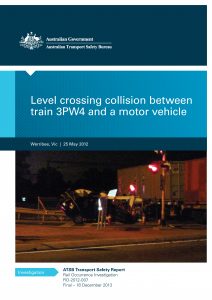 This writer has read several ATSB reports while working in the rail industry and knows firsthand of the respect the reports are given by rail operators and others. Without opening a specific report, this web summary of one, picked at random, is a useful example of the knowledge that can be made available. The investigation summary into a Level crossing collision between train 3PW4 and a motor vehicle, Werribee, Vic, on 25 May 2012 includes four elements:
- What Happened
- What the ATSB found
- What’s been done as a result
- Safety message
The webpages of OHS regulators in Australia rarely, if ever, provide this type of information and yet there is enough on the one page linked above for a decent understanding of the cause of an incident and its effects. The full report is, of course, also linked on the page, and the ATSB should be commended for producing reports that are not laden with so much technical information as to negate any broad safety benefit.
This level of detail would provide relatives of the deceased some information about the mechanisms that led to the incident, as well as show how the world has changed as a result. It can provide the “how” and some of the “why” without going through the long, complex, and traumatic Court processes to find answers.
Equally important is the establishment of a library of case studies and safety knowledge that is accessible to all at no cost – the original intent of internet communications.
An Australian Workplace Safety Bureau may never happen, and if it did, it would not stop the calls for justice and answers about work-related deaths through the court and legal processes. But it would provide a reputable source of real world heath and safety information with integrity and independence.