
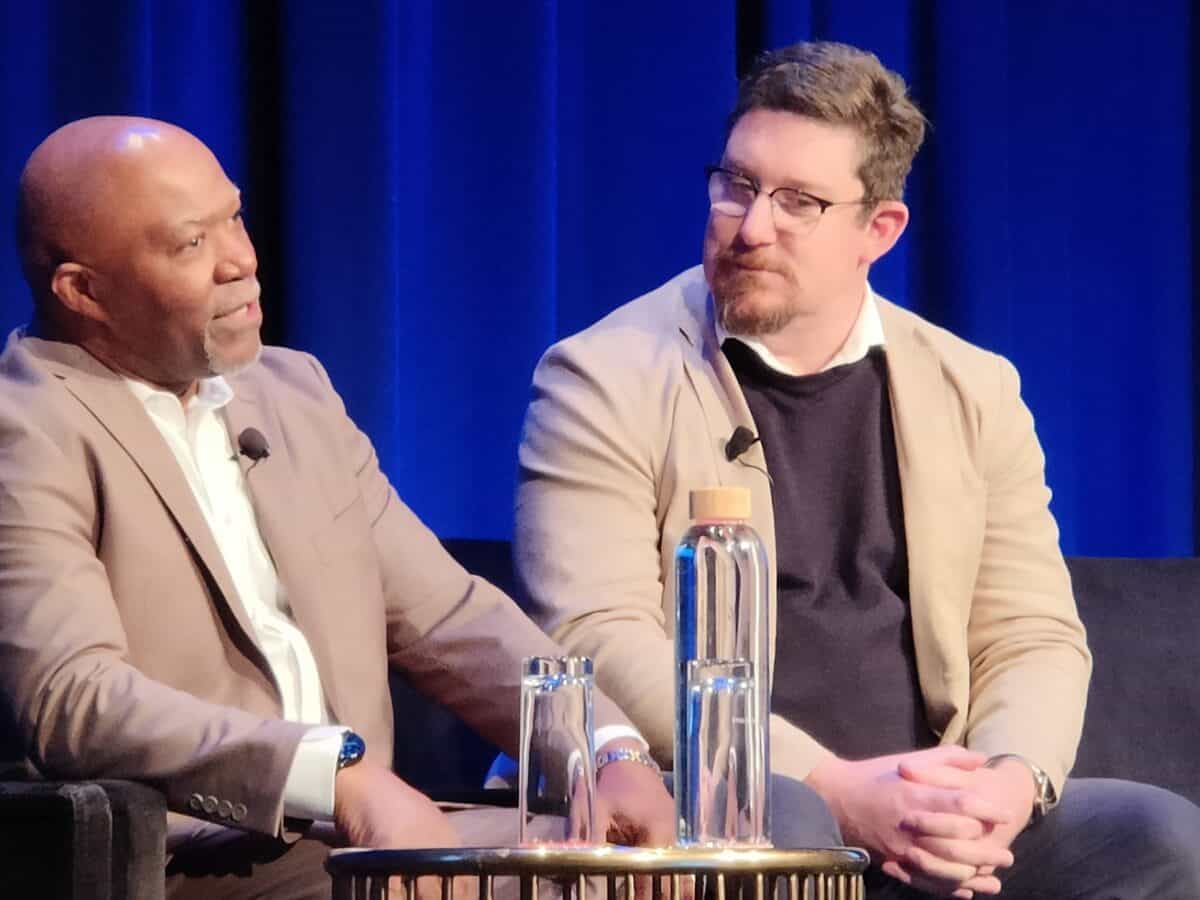
Many conference delegates spoke highly of international speaker I David Daniels at the recent Psych Health and Safety conference. Daniels has a long occupational health and safety (OHS) career and hosts the United States version of the Psych Health and Safety podcast. His OHS perspectives, including his discussions about race, were significant.
Daniel’s values were immediately displayed before his interview with Wade Needham commenced. He had assembled some of the conference venue staff at the rear of the room and asked delegates to applaud the workers and their service quality.
He also provided a cultural snapshot of his experience growing up in the US and his C-suite experience:
“I generally don’t spend a lot of time in the C-suite. Because have you looked at the C suite recently? It’s not a place I necessarily get an invitation to, because I’m not in the country club. I don’t go to school with their kids. It’s not that I’m necessarily a good or bad person, and neither are they; we just haven’t had familiarity. Maybe they weren’t raised on my street. The Fortune 500 in the United States doesn’t generally look like me. So we don’t hang out in the same places, and so we don’t have the opportunity to be able to share. And I’ve got some interesting things to say, and so do they. But we just don’t often cross.”
From here, the interview discussed social diversity’s importance in OHS management and organisational culture, offering a new perspective on why some people feel that a company’s culture is just not the right place for them:
“….. it’s said that about 50 million new businesses are going to be created on the planet every year, about 137,000 a day, new businesses. Those businesses tend to be set up to work for the person that created them. And that’s not a good or bad thing. It’s not a judgement, but it’s made in their image. It’s made based on what they think is important. And again, that’s great, until they bring that second person and 10th person, and 1,000th person. Many of these systems are still set up to be safe for the people who started them.”
This perspective is particularly relevant to the issue of recruitment. Applicants need to understand the organisational culture in which they seek employment, but frequently, we cut a suspicious culture some slack because we need the job. And sometimes, the workplace culture is not accurately represented in the recruitment process by the Human Resources (HR) personnel because they also want to fill the job as quickly as possible. We may need to focus on (psychological) Safety in Recruitment to echo the importance of Safety in Design. Daniels discussed this because he did not clearly understand what was involved with his job as a firefighter in the City of Seattle. (This echoed some of the points made by Zagi Kozarov in the same conference)
“…if I know what I’m getting myself into, I can prepare myself. Because okay, so at the [interview] I know there’s going to be some of this, and in return, there’s going to be some of this. I knew when I started with the City of Seattle as a firefighter that I was going to be going into buildings on fire. I knew that. Matter of fact, they taught us really well how to do that. What they didn’t tell me, is I’d be seeing people die in front of me. I was 21 years old, and I show up at a guy’s house, and he’s talking to us and an hour and a half later, he’s dead. Nobody told me about that. Nobody told me that a year and a half on the job, I see my first colleague die. Nobody told me over the course of 32 years, I’d seen 30 people, 30, three-zero people, who either got killed at work or died from something they were exposed to at work. They didn’t tell me that part. So I had to figure that part out on my own. And ultimately that’s the lasting legacy of the entire experience.”
Often, we are encouraged to “bring our true selves to work”, but why would we expose ourselves to a level of social scrutiny that could cost us our jobs? We all wear masks to operate effectively within the cultural mores required by our employers.
Daniels said:
“… One of these days, I would love to meet Dr Edmondson. I would love to be able to chat with her. I haven’t been able to do that, but I’m an admirer of her work. But there’s a kind of a thing with advising people to bring their whole self to something that wasn’t designed for their own self.
So for your own self, we want you to feel safer, but you didn’t design it for me to be able to do that. And a lot of it, again, not good or bad. I say often that we’re generally expected in most of our professions to be clothed when we come to work. And that’s not a good or a bad thing, unless you work in one of those clubs where they don’t wear clothes. But it’s about context. But often we don’t make that clear to people. All we think about is ourselves. I created it, it’s safe for me. If you’re coming here, you’re going to have to be like me. And it’s okay for you to be like you, but I want to be like me.”
One of the contemporary struggles for many employers, workers, and OHS professionals is that people’s experiences of psychosocial harm and safety vary. We are not used to diversity as our means of production, and workplace cultures rely on uniformity of purpose and values; in fact, we induct people into our homogeneous organisational culture. Daniels says
“My definition of a psychosocial hazard is unique to my research, and a psychosocial hazard is a psychosocial factor that’s perceived or experienced by the person exposed as a threat that, in turn, causes them to behave in a different way……
So we create these wonderful systems that get created by whomever, and we don’t consider that we are all just different. And there’s some folks that think, oh, that’s just way too much work for us. No, actually it isn’t, because a lot of these mitigation strategies are really pretty easy, and the data is in the room that says, that doesn’t work well for me. And I feel comfortable not saying that, and the thing that would be more comfortable probably will save you money. It’ll certainly make you more effective. It might make us all better. It may not.
But if we have these kinds of environments that are designed on the front end that way, so what if we started a business, this start-up, and from the beginning we assume that this is about creating a psychologically healthy and safe place for all the humans we’re going to bring in. And whether we make money or not is secondary to that. Wouldn’t that be interesting? Because I submit that you’ll make more of it.”
I David Daniels expanded on his thoughts about how employers design workplaces for themselves or their cultural clones and how this may be causing recruitment problems:
“Most of the responsibility is on the employer. Because you started the business, you determine what happened and you were going to expose people to. You wrote the job description, or didn’t. You interviewed this person and called their cousin and told him to come work for you, or however you did it. You brought that person into the environment. You have more control, more influence, more ability to make a difference than the worker does. “
Daniels pointed out that Gen Zers and Gen Alphas are unlikely to want to work in “old school” work environments that do not provide them with respect. Sure, those workers may have a heightened sense of entitlement, but this should not result in them being dismissed as “up themselves”. We should not, perhaps, “blame the workers” for not fitting the culture we created. Just, perhaps, the culture needs to evolve.
Daniels’ participation in the conference was important because he provided a new voice in our consideration of psychosocial hazards at work and the context of their generation and management. In many ways, he was preaching to the converted (the conference had few diverse perspectives on mental health at work). Still, he did so in a fresh way, drawing on experiences foreign to most Australians in the audience.
He also closed his interview with a live cross to his mum in the US, showing her his achievement and having the audience wave and say “Hi”.